Foster Observatory
Manuel Foster Observatory of the Catholic University was installed on San Cristóbal Hill in 1903 by the Lick Observatory of the University of California, at a time when most of the large instruments were in the northern hemisphere.
The construction of the Observatory was authorized by President Germán Riesco, becoming the first building to occupy the summit of Cerro San Cristóbal. Although the original idea was to install the telescope in the country for only three years, the successful scientific mission and results obtained managed to prolong the observations for another twenty-five years. In 1928 the Pontificia Universidad Católica de Chile received it as a donation from the prominent politician and professor at the same university, Manuel Foster Recabarren.
The main objective of the telescope was to compile a catalog of radial velocities of bright stars in the southern hemisphere. During its first years of operations, it was part of the nine largest telescopes in the world, so its findings were of great historical importance for the development not only of national astronomy but also worldwide. Thus, the observations made from the Manuel Foster Observatory marked the beginning of astrophysics in Chile.
The scientific instruments installed at the observatory were manufactured between the end of the 19th century and the beginning of the 20th. The telescope’s primary mirror has a diameter of 93 cm (36.6 inch) and weighs 252 kg (556 pound), while the secondary mirror measures 24.2 cm (9.5 inch).
In the 1930s and early 1940s, observations of variable stars were made by a small group of professors and assistants under the direction of Dr. Erich Heilmaier. The Observatory ceased its operations for many years until its restoration began in 1980. In the process, technological improvements were made that do not affect its historical character. The objective of the upgrades was to increase the efficiency of the telescope and mitigate the effects produced by the radio and television antennas that surrounded it, in addition to the increase in the luminosity of the city.
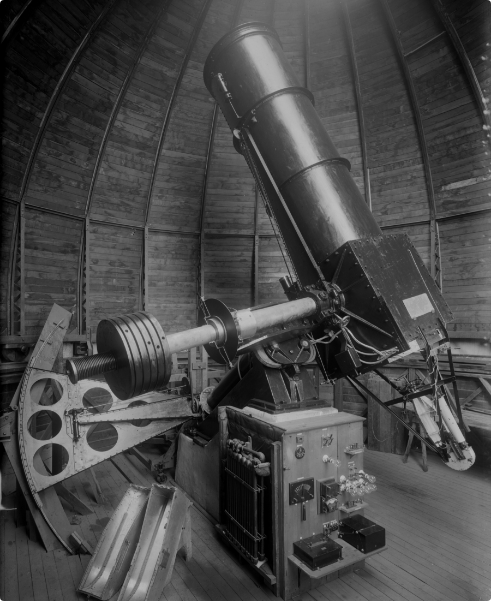
Since 1982, the Manuel Foster Observatory was used again for research, teaching and outreach activities. In 1986, observations of Halley’s Comet were made for the general public and, a year later, of supernova 1987a (the closest to Earth in the last three centuries). The rapid growth of Santiago, as well as the progressive increase in access to the large and modern observatories of the north of Chile, reduced the frequency of observations at Foster, which ceased operations again in 1995.
The telescope has been minimally intervened over the years and is in the same condition as it was more than a century ago, which makes it a unique historical instrument in South America. In 2010, the Manuel Foster Observatory was declared a National Monument in the category of Historical Monuments.
How to get there
There are different transportation option to get to the Foster Observatory on Cerro San Cristóbal. The Metropolitan Park does not allow private vehicles to enter. If you prefer to enjoy a walk, you can access the Parque Metropolitano from the main entrance, located at Pedro de Valdivia Norte. From there, follow the signs that will guide you to the top of the hill. A beautiful experience for adults and children is to take the cable car from the Oasis station (near the Pedro de Valdivia entrance) to the Cumbre station. An alternative is to use the funicular from the Pio Nono station, an iconic means of transport that will take you directly to the Cumbre del Cerro station. From there it is a short walk to Plaza México and to the top of the hill. Once at the top, you will find the Foster Observatory, where fascinating astronomical discoveries await you.
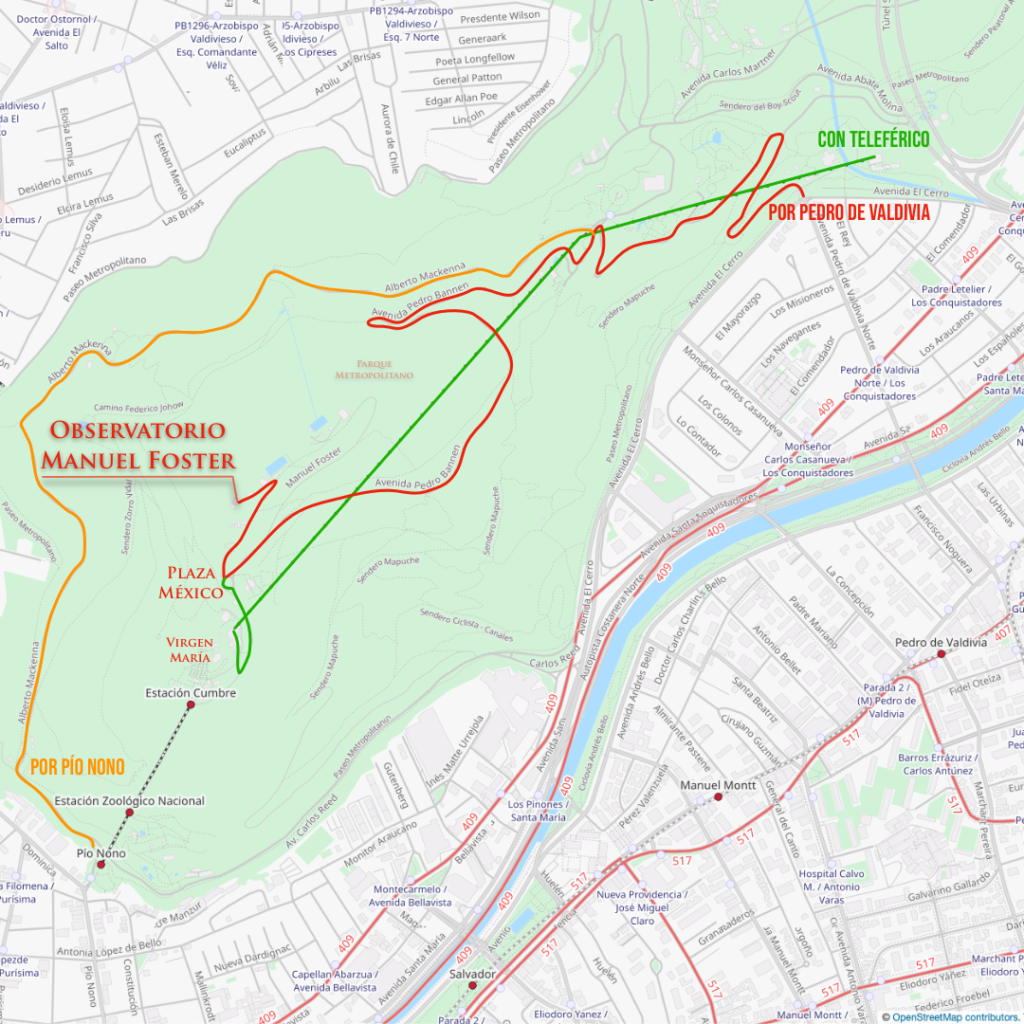
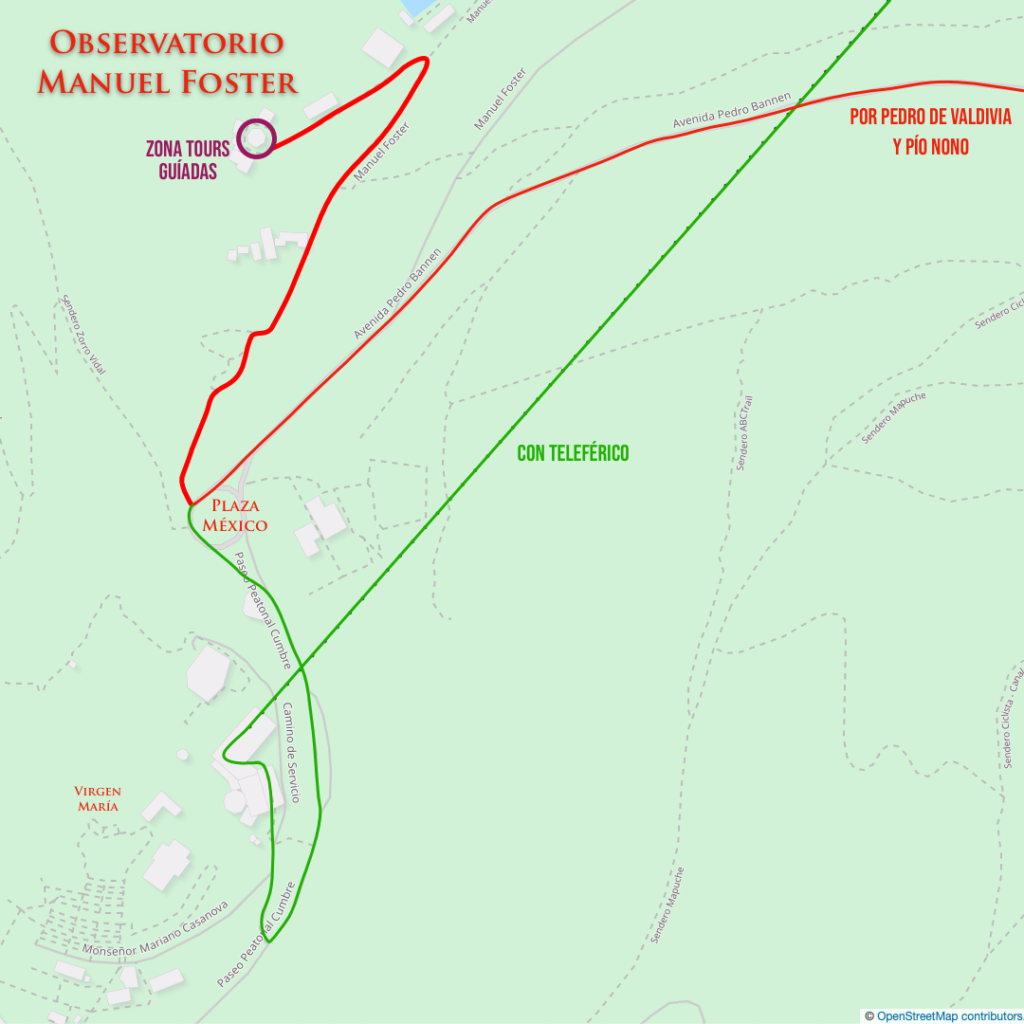
No matter the means of transportation you choose, we assure you that the trip to the Foster Observatory will be the beginning of a fascinating adventure into the world of astronomy. Remember to check the opening hours and plan your visit to fully enjoy this unique experience in Santiago.
Day and night visits
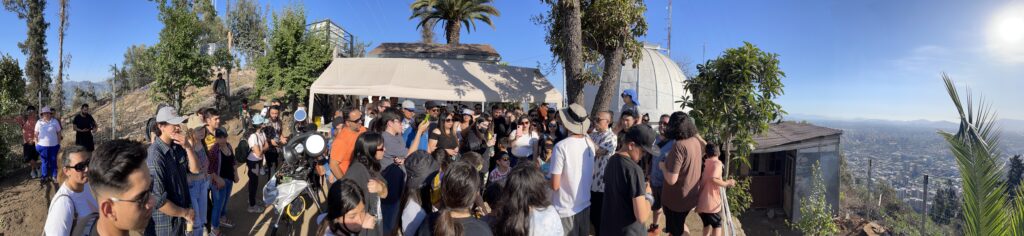
The Foster Observatory is open to the general public on Saturdays and Sundays — from 12:00 to 18:00 in summer and 11:00 to 17:00 in winter. No reservation needed for daytime visits.
Night observations include an astronomy talk by Institute of Astrophysics astronomers followed by direct sky viewing with modern professional telescopes. Spots are limited — check current rates and book in advance at observatoriofoster.com.
Schools, courses, and groups are welcome throughout the year by prior arrangement. Book a visit.
If you have any questions, you can write to observatoriofoster@gmail.com or follow the Observatory on its Instagram account (@observatoriofoster) to obtain updated information on the outreach activities that we carry out there.